Categories
Business Thought

Stakeholders | Creating the Virtuous Organization

Shareholder primacy has been the primary philosophy dictating business practices and priorities for decades. A virtuous organization rejects the doctrine of shareholder primacy, recognizing the pressure it places on organizations to make unnecessary social sacrifices at the expense of financial gain for a single stakeholder. Instead, a virtuous organization follows a stakeholder theory model, where a responsibility to consider the needs and value creation for all influences decision making. Virtuous organizations are willing to sacrifice the costs of a more short term financially profitable decision in favor of a decision that long-term maximizes overall value creation. 

In considering its stakeholders, a virtuous organization thoroughly assesses the individuals and groups that its work touches. It works wisely within the tension between meeting the needs of the individual and benefitting the whole, including recognizing the significant role of business in shaping society and individual experiences and being shaped by both. A virtuous organization also proactively gives the environment a seat at the stakeholder table. 

A virtuous organization is able to make space for all stakeholders to participate in its mission. When stakeholders feel heard and respected by an organization, they will be committed to its success and empowered to express their values through their participation in the organization. 

Categories
Business Thought

Strategic Alignment | Creating the Virtuous Organization

When different parts beautifully fit and flow together, it’s called concinnity. The word has popped up in books about corporate governance because it can be one of the most beautiful things to see in business: the arrangement of people, processes, and systems to balance the diverse goals of stakeholders as a company pursues its mission. Virtuous organizations see strategic alignment as the beautiful fit and flow of the organization’s structure and resources with strategy and the business environment, including the opportunity to create social value. 

Research backs the notion that an individual should pursue talent over passion (if the two collide). The insight is that passion develops as a result of competency. It is more likely that an individual will end up caring about issues they contribute impact towards, than that they will have an impact on issues they initially care about. Individuals also have more value and more impact when they are put in conditions that allow them to do what they are good at, under just the right amount of pressure or challenge. Skills are challenged and tested under new circumstances to the point an individual feels immersed in energized focus, fully involved in the process of the activity. The short lesson: to maximize impact, start with what you are good at.

Similarly, the virtuous organization knows the importance of working diverse skills and experiences into exceptional, sustainable leadership teams and then providing them with clear strategies and good governance before letting them loose. This structure allows for the emergence of concinnity, as the parts arrange for the best experience. As long as we’re throwing out words that are hard to pronounce *every* time, the psychologist Mihaly Csikszentmihalyi called this aligned state, experienced by individuals and organizations, flow. When teams are not strategically aligned, and something is amiss when the structure, resources, strategy, or environment, red flags fly in the form of a phenomenon called social loafing.  

Maslow also weighed in on the importance of alignment in his principles of enlightened management. He pointed out that team decision making, personal fulfillment, and organization productivity are all much more tightly connected as workers become more autonomous, self-respecting, and highly educated. 

It’s this same strategic alignment, of different and distinct parts of a whole being arranged towards a strategy of social value (organizational mission), that drives impact. Researchers Kaul and Luo have written about the value of strategic alignment and corporate responsibility. They find that a company can create social and financial value under two conditions: first, that it uses its core competencies for corporate responsibility (as opposed to other contributions) and secondly, that it chooses a cause that isn’t already polluted with other organizations working on it – competition isn’t good in the social impact space. In short, aligning an organization’s strengths with an unmet need leads to the greatest social and financial value creation. This study provides added insight into the demonstration of an economic case (as opposed to an ethical case) for social impact in businesses. 

The lure of strategic alignment is that it creates synergy, or in other words, there is significant additional value creation without consuming additional resources.

This is the type of value creation that virtuous organizations are incredibly interested in harnessing for social good. But, this type of alignment takes work and skill and persistence. 

Organization missions hold steady. But organizational structures and strategies often change, which make alignment a challenge. Aligning teams, divisions, and the business as a whole are each difficult in their own right. Thus, the shift of Facebook from a culture of “move fast and break things” to “move fast with stable infrastructure.” Less fun, but more aligned and impactful. 

Virtuous organizations regularly ask themselves how well the business strategy supports the company’s deep purpose. They also use data to see how aligned the organization is in supporting the achievement of organizational strategy through resources, management, and required capabilities. If a business mission includes elevating humanity, and a part of the business strategy is to provide superior customer service, is this reflected in the day-to-day behavior of staff in their interactions with each other and with customers? Symptoms of poor alignment are often obvious, especially to those who work in the organization, but also to other stakeholders. 

Strategic alignment is concinnity. The harmony manifests itself in more than just one note of the virtuous organization. It shows up in a symphony of superior financial performance, social value, a more positive work climate, above average staff engagement, a stronger commitment to values, and fewer turf wars. In a virtuous organization the process, product and experience of being a part of the organization all serve to achieve the organization’s mission and elevate society. The buzz created by the strategic alignment is part of the power of a virtuous organization: stakeholders value being part of a company that is elevating. 

Categories
Business Thought

Coorperate Responsibility & Integrated Goodness | Creating the Virtuous Organization

This is an exciting time for those who care about integrating their desire to improve the world with their day-to-day work life. From social enterprise to corporate responsibility, from green workplaces to diversity and inclusion, organizations are creating and sustaining social value in ways never seen before. Doing good is no longer the mandate for just nonprofits, and using sophisticated analytics and management approaches is no longer expected of only governments and corporations. The roles, definitions, and strategies of organizations across the sectors are blurring. This is particularly true when it comes to the desire to leverage organizational resources to do good. 

Corporate responsibility initiatives have become increasingly common and expected from companies around the globe, and current efforts can fall into three broad categories: philanthropy (donating time, money, product, or expertise), integration (building more equitable practices into regular business), and innovation (developing new business models that inherently address social and environmental challenges). The organizations who are best at corporate responsibility ensure their initiatives across these three segments, support and leverage one another, are effectively measured, and are unique to their organization’s assets, resources, capabilities, and mission. 

However, as organizations reach this new level of maturity in their explicit social impact and corporate responsibility initiatives, several common mistakes still plague these efforts. We’d like to address four of the most prevalent critiques. 

1. The minuses of the credits/debits approach. “If we do harm here, then do good there, it all evens out.” At its most innocent, this attitude reflects a lack of strategy in an organization. At its most pernicious, this attitude reflects a conscious attempt to misdirect the public with falsehoods about an organization’s value commitments as seen in practices like greenwashing or pinkwashing. Virtuous organizations seek to maximize value in all facets of their operations. This means working to maximize wealth and prosperity, the inherent benefits of the product or service being sold, and the good that comes from strategically related efforts like philanthropy, while simultaneously minimizing harm. 

2. The hazard of haphazard giving. This refers to the lack of systematic care in the use of funds and other resources toward social or environmental causes. Why donate a dollar when giving an aligned dollar could easily triple the impact of the social investment? Organizations can create the greatest good by leveraging their proprietary mission, capabilities, talent, and other assets to make a unique, strategic contribution in an area that aligns with their expertise, industry, and values. 

3. The problem with doing well by doing good. While well intentioned, emphasizing the primacy of financial outcomes as the rationale for corporate responsibility can actually be counterproductive. Instead, for virtuous organizations, the rationale for doing good is integrated with the case for every other activity carried out by the organization. 

4. The ignorance of the “we know best” approach. Rather than assuming they can do it best, virtuous organizations focused on mission fulfillment partner with organizations that deeply understand the roots of social and environmental issues and choose to employ approaches to corporate responsibility that uphold the dignity and wisdom of the communities they serve. 

Virtuous corporate responsibility rests on two foundational principles of strategic alignment (using unique strengths, capabilities, assets, and mission to elevate society through a social mission) and value maximization (multiple objectives for multiple groups is simultaneously achieved). The implementation of these principles together often divides virtuous organizations from organizations that engage in current corporate responsibility.

Virtuous organizations inextricably weave their prosocial intentions and practices throughout their systems, rather than building a corporate responsibility program that may be a loose appendage to the mission, core product, and stakeholders of an organization. 

This perspective is derived from the internalization of the virtuous organization mandate to deliver value to multiple groups of stakeholders, recognizing that their responsibility and opportunity goes beyond simply enriching shareholders. This value maximization philosophy enables organizations to solve some of the world’s toughest challenges, by seeking to maximize both financial and social value for all their stakeholders. 

The roadmap, then, for developing more virtuous corporate responsibility includes choosing initiatives that strategically align the organization’s mission, vision, and values with an important social and/or environmental challenge. Once this congruence is in place, initiatives are designed in partnership with the people they are meant to serve and by defining a clear theory of change. As with the most critical parts of business, these programs have metrics that are developed and deployed to track performance and impact. Rather than considering corporate responsibility as a separate function of the organization, virtuous organizations consider the creation of social value to be an integral part of their strategy. 

Categories
Business Thought

Impact | Creating the Virtuous Organization

Aligned with its deep purpose, and fully recognizing how all of its resources and competencies create social value, a virtuous organization goes beyond just embedding the intention to do good into the fabric of the organization. A virtuous organization realizes that it can move the needle on solving social problems, creating value and having a meaningful impact. 

In order to become a virtuous organization, you must treat corporate responsibility efforts as an integral part of your operations, rather than as an appendage to your other work. To do this, you choose an issue or cause that requires the unique skills, brand, or resources you can offer and then strategically incorporate that work into the organization. By doing so, you avoid the significant pitfalls of corporate responsibility efforts that end up labeled as a marketing or PR scheme, or that washout when the enthusiasm of a key individual wanes or departs the organization. 

Central to all virtuous organizations is the practice of strategic alignment. This alignment to the mission happens in all facets of the organization, but happens in reverse when an organization mobilizes to address a specific social cause. In addition to aligning all aspects of an organization to the mission, the organization strategically selects a cause that aligns with its organizational strengths. This strategic alignment throughout an organization increases its integrity and power for work that produces far reaching social impact.

Categories
Business Thought

Product Mix & the Best Life | Creating the Virtuous Organization

Successful organizations create and deliver value, partly through the product or service that helps them gain revenue. Additionally, a company’s core product mix is how they primarily interface with their customers, representing their primary interaction with the world. This interaction is where an organization’s impact on the world begins. In a virtuous organization, the firm’s core product mix actively avoids causing harm and ideally makes the lives and wellbeing of their consumers and communities better. 

The core business of a virtuous organization actively avoids restricting any person from achieving their basic human needs or rights; rather it helps people to achieve some element of at least one human need. Consistent with the deep why approach to organizational mission, Maslow’s hierarchy of needs can be a framework for understanding the way an organization’s products and services create and deliver value to meet human needs. By understanding how a company’s product mix meets human needs, an organization can use their product mix to help people live their best lives. 

In general, products are created for a positive purpose, but they can have negative side effects or be misused in ways that are harmful. Other products are believed to be good at one time, but later on the company or customers discover that the product has negative effects. For example, the many effects of products like tobacco and sugar, or technologies like cell phones and social media platforms, have been understood as negative only with the passage of time. A virtuous organization is responsible and accountable for the impact of its products, services, and processes on people and the world. If a product or service causes harm, the company that produces it should be the first to identify the harm, publicize the harm, and respond in ways that minimize and repair damage. 

Even after an organization has identified how their products and services fill human needs, they may face challenges in ensuring that their product is being used in a way that helps people reach their best lives. We have identified four ways that a virtuous organization will respond to this tension. 

The first way a company can mobilize its products and services to help people live their best lives is by designing their product with a purpose mindset. Sometimes companies get caught in a product mindset – seeking to improve the features of their existing product mix – instead of a purpose mindset – which leads organizations to innovate solutions to the problem they intend to solve. Organizations who focus on their purpose will identify options that solve the consumer problem in vastly diverse ways. By adopting principles such as those taught in design thinking (prototyping multiple solutions to the same problem based on the insights of those the product is designed for), organizations can consider many paths to solve a single problem and then identify low- or no-harm solutions to introduce while still accomplishing their overall purposes. 

Another strategy a virtuous organization may use to help people live their best lives is to nudge consumers to use their product mix in ways that negate unintended harm and increase the positive effects. Behavior economists Sunstein and Thaler explain the idea of “libertarian paternalism,” or respecting people’s ability to choose while nudging them in a positive direction. The heart of this idea is that organizations inherently shape the environment in which people make decisions. Without force, organizations can strive to help customers make the choice that is believed to be in their best interest. For an organization, this may lead to careful, strategic trade-offs to help consumers use their product for its “best life” use rather than for the more lucrative use. 

If a virtuous organization finds that their product creates harm, they will actively seek to develop a no/low harm product to replace their original product. After find-ing a solution, they may find a way to subsidize the no/low harm product in order to encourage consumption. Companies who take this path will then find a way to scale and drive down the costs of the more virtuous option until the virtuous product meets or exceeds the profitability of the original product and replaces it in the market. In this way, they are not only promoting the use of better products, but are creating a long-term, economically viable solution for their business that will keep them ahead of competitors.

Finally, a virtuous organization will always acknowledge and be accountable to the potential risks of their product or service. Organizations that find it difficult to introduce changes that lead to better use of their product must educate their consumers on how to reduce the harm that can come from their products. Virtuous organizations will actively actively educate their customers of those risks while working to mitigate or remove them. 

In designing, developing, and sharing their product mix with the world, a virtuous organization will recognize the way their products and services communicate their values and help them accomplish their mission. They will strive to deliver value to their customers to help them live their best lives.

Categories
Business Thought

Profit Prosperity | Creating the Virtuous Organization

Economic sustainability is imminently consistent with the principles of a virtuous organization. One of the greatest contributions of business is the generation of wealth. Wealth raises the standard of living in communities by providing opportunities to create jobs, to sustain livelihoods, and to make resources available to others who share an entrepreneurial spirit. Businesses create and distribute value, and in many cases, the best way to provide that value is to ensure that the organization continues to survive for the intended and reasonably expected life of the purpose it serves. Thus, the virtuous organization is not an anti-profit philosophy. 

Milton Friedman’s shareholder primacy theory has been the normative doctrine in business schools and in practice for decades. However, the law does not compel corporations (or the people who run them) to sacrifice any other organizational interests in favor of dividend checks. Corporate law scholar Lynn Stout wrote a compelling argument suggesting that any reference to case law requiring profit maximization was patently false. As even Friedman – famous also for railing against corporate social responsibility – pointed out, shareholders are people. They invest in ideas and philosophies and values as well as opportunities for financial gain. 

Ultimately, virtuous organizations don’t exist solely to maximize profit for shareholders. Rather, virtuous organizations seek for economic sustainability, or the ability to financially support the needs and goals of their organization’s mission and purpose for its intended life duration while simultaneously distributing prosperity and value – tangible or intangible – ethically and fairly to all stakeholders. Virtuous organizations create both economic and social value. 

There is a relatively large body of research that suggests that investments in social performance also increase financial performance. While the details of the mechanisms behind this phenomenon are still a matter of debate, one thing is clear: customers and investors respond positively to opportunities to involve themselves with businesses that are interested in social value and not just financial value. 

This concept suggests that transparency is central to real fiduciary responsibility. So long as investors and consumers know what the company stands for and how it intends to spend their money, the choice of whether or not to invest or purchase – to risk their own capital – belongs to investors and customers themselves. If an investor chooses to allocate their money to a company with a social mission, they may expect a financial return on investment, but they will also expect a social return on investment that will provide them with non-financial personal value.

Capitalism facilitates value creation through business that extends beyond financial success. Take the importance of job creation as an example. To value jobs means to also value people. Jobs allow people stability. They pay for meals and mortgages and college educations. They provide an essential fabric that is woven through families and social networks, the rhythm of days and weeks. Jobs provide much more than just paychecks. Having a commonly-recognized currency has also provided enormous value to society. Currency allows individuals to make complicated trades in a free market and has exponentiated human growth, development, innovation, and prosperity. With money, people can purchase what they value. The freedom to choose with one’s own resources – assuming they have such resources – is a powerful force in support of self-actualization. A virtuous organization recognizes that they create financial value through profit and job creation, but they also acknowledge that they create social value through building community for their employees, facilitating innovation, and allocating important resources to corporate responsibility efforts. A virtuous company takes its profit and devotes it to increasing the firm’s ability to create all types of value. Reinvestment in the activities of the organization is key to a virtuous cycle of value enhancement. Innovation, expansion, and quality improvement only result if the invested funds can be used to generate them through research and development, excellent strategy, and wise infrastructure investments. This sort of reinvestment is expected by investors. It’s what they are investing in. The concept of reinvestment emphasizes that the value intended from this kind of capacity building activity can be viewed as independent from financial returns on shareholders’ investments. If an organization is mission-focused and working toward its vision for the world, greater reinvestment can translate to real gains for society. An organization committed to such a vision will align their growth and innovation strategies with new, better, cheaper, faster ways to get things of value to the people who need them. That might mean cleaner energy and more and better medicine, shelter, education, and art. 

Categories
Business Thought

Signature Strengths and Core Competencies | Creating the Virtuous Organization

Organizations have enormous potential and ability to create value. The art of business is to combine and harmonize skills and resources to uniquely provide what customers want and subsequently distinguish themselves in the marketplace. To do this, they use their core competencies, or signature strengths. 

Core competencies include specialized knowledge, techniques, or skills – even beautifully called a “distinctive collective learning” – that the company uses to develop core products and new business. While core competencies are difficult and challenging to achieve, and are of great import in keeping a business competitive, these same competencies are what the virtuous organization sees as key to making a truly impactful contribution to all stakeholders and generating both financial and social value. Core competencies (and resultant core products) are used for profit, product, and differentiation, but these treasures easily become traps if not extended to fulfill the organization’s mission and elevate society. 

Business leaders are valued for being future-facing and highly skilled at developing industry foresight that is necessary to adapt to changes. They must also be wise in controlling and managing resources that will enable the company to attain goals despite any constraints. To avoid falling into the profit, product, and differentiation traps, virtuous organizations build with a long-term view, thinking about all stakeholders and focusing on new value creation.

Virtuous organizations realize that it is their core competencies – their “engine of development” – that allows a prescient point of view where they see their position to provide value and leadership in contributing to broader social good. 

Research warns against the common tendency for a corporate responsibility initiative to reflect a pet interest of the founder, an executive, or employees, rather than drawing on the use of a company’s signature strengths. The organization might also follow the trends of current prevailing political or social issues, thus having limited (and sometimes even negative) social impact. Instead, virtuous organizations zealously consider the value they can create when they combine their signature strengths with a currently unmet need in their community or society. By aligning signature strengths with a strategic social need, there is ample evidence that demonstrates a business can create both social and financial value.

In order for a virtuous organization to mobilize their signature strengths for full value creation (social and financial), it must first identify its competencies. In order to deliver unique value, companies identify, hone, and even perfect core competencies. Then they integrate these competencies into their core activities to generate that unique value. A framework for a rigorous review of company core competencies may start by looking at company purpose, principles, process, and people. Companies may also consider their resources, products, priorities, and partnerships among their signature strengths.

Purpose. An organization’s statement of purpose, or mission statement, may be its signature strength to the extent they align all activities to that purpose. The opportunity of a virtuous organization is to connect any statement of strategic intent that defines a company and its markets to its clear deep purpose (why the company does what it does) and core competencies (how an organization does what it does) for significant and sustainable impact. 

Principles. Whether a business provides a product or a service, there are values and principles that, when applied, bring an organization closer to the process and product desired. An organization whose principles are clearly communicated and implemented may consider those principles to be its signature strength, or its way of adding unique value. For example, a company deeply committed to the principle of preserving the environment may give employees certain days off to engage in organized environmental conservation or regeneration activities. 

Process. Another organizational signature strength may be a company’s processes, including processes like governing by council or a unique assembly or distribution line. In a unique combination of culture, core competencies, and end product or services, organizations tend to develop formal rules and processes that are most likely to yield the most value creation. Once refined, these unique processes can be used in a variety of situations and contexts. 

People. Organizational core competencies and employee competencies are different. But one of the most unique assets of a firm is its workforce. A company’s work-force develops a knowledge set and culture that is incredibly difficult to replicate. The signature strength of an organization may be how it invests in the development of its employees, knowing this is part of what will make them more valuable in the long term. 

As virtuous organizations identify and utilize core competencies to create more value for all, there is a deeper understanding among stakeholders of the potency of organizational alignment, including among those overseeing resource allocation. When a company communicates its core competencies well, it feeds a culture of innovation, particularly when met with resources. New markets can be invented, emerging opportunities are quickly met, and stakeholders will be delighted by needs being met that they didn’t even know existed. When prioritized, these company initiatives are folded into the core business as sustainable, and they widen the ways in which the company uses its signature strength. 

There is an open flow culture among organizations who view themselves as a “portfolio” of core competencies that can and will be shared to increase value. It encourages effective work across organizational boundaries, sharing of resources, and long-term thinking. Virtuous organizations actively identify and invest in next-generation core competencies that are strategically aligned with the value they can bring to all stakeholders and the broader community. 

Categories
Business Thought

Value Creation | Creating the Virtuous Organization

An organization striving for positive social impact looks beyond markers of financial value to consider the full value they can create through their products, processes, and purpose. This comprehensive view of value creation includes the social value they create in addition to the financial value. The metrics for each of these kinds of value creation are equally important to a virtuous organization. 

The virtuous organization perspective does not discount the social benefits of generating wealth. It recognizes that businesses play a vital role in creating jobs and livelihoods for much of society. It also validates the importance of business sustainability, or a business being profitable for the duration of its life. The virtuous organization perspective validates all this, and pushes businesses to account for the value they create more comprehensively. 

To maximize their value creation, a virtuous organization understands how it can use its signature strengths to help people and society reach their full potential. The expression of signature strengths is often captured in the product mix of an organization: the products and services a company creates to generate revenue. By mobilizing its signature strengths in line with the organization’s purpose, a virtuous organization can increase its overall value creation. 

Categories
Business Thought

Elevation Empowering Agency | Creating the Virtuous Organization

The principle of elevation creates a new breed of engaged agents on all levels of an organization. There are strong and clear signals of a company with high value that cannot be captured on paper. The customer who keeps coming back and intuitively serves as a brand evangelist to their social circles. The employee who feels not only proud and engaged in their work, but excitedly talks about the work of the organization and its impact to all who will listen. The shareholder who draws in other investors because their sense of a return on investment goes well beyond their dividends. These are situations that come not by an organization having a mission statement, but by organizations that embody a mission that individually and collectively elevates stakeholders. 

The virtuous organization mission is not just any mission: it empowers people to choose and express their values and to choose and live their best lives. Key characteristics of a virtuous mission include: 

A shared purpose for stakeholders to connect to

Clear communication of vision and values

An acceptance of values plurality and the resulting tension 

When a virtuous organization determines its mission with these concepts in mind, its stakeholders will be empowered to pursue and live their individual values. By creating space for this expression of values, a virtuous organization will elevate society. 

A virtuous mission creates shared purpose. The clarity of the mission and vision draw stakeholders, and once connected, there is little else that can create stability, sustainability, and profitability like this values-driven loyalty. This type of connection comes only as the individual and the organization fuse on a shared deep purpose, which typically calls out the deepest of human and social potential. 

Indeed, the mission of an organization can elevate individuals to identify, articulate, and exercise their values in a way otherwise far too difficult to accomplish independently. Connection to a business mission can actually inform and expand individuals in how to exercise their own values, drawing together people into powerful communities with the power to change the world. 

A virtuous mission clearly communicates the organization’s vision and values. Anyone who has written or read a mission statement knows that the words themselves are rarely a transcendent experience. Clarity in these organizational statements is important, but the critical work rests with the organization to reify their vision, mission, and values through action. This is not easy work. If the mission is permeating the work of the organization, the elevating impact can be felt on everything from employee recruitment and engagement, to organizational strategy and culture, from community and social impact to customer and shareholder interest.

Because mission permeation is critical to improving organizational success, productivity, and performance, it is a high-worth practice to regularly review and revise (if necessary) the mission statement to best align to the deep purpose of the organization. 

A virtuous mission accepts the tension of values plurality. Values can be a loaded word. Talk of shared values can quickly decline into a moralistic debate. A virtuous organization, however, realizes that a marketplace of values with transparency and differentiation allows for people to robustly choose when and how to engage with organizations in pursuing their own values. This marketplace acknowledges values plurality, or the idea that there are several values which may be equally correct and fundamental while being in conflict with each other. For example, consider the tension between efficiency and effectiveness, quality and quantity, justice and mercy. This tension creates a space where different values can complement each other and allows people to thrive because they are able to choose and explore their own values. This is, in itself, elevating. 

Embracing value plurality does not mean virtuous organizations are open to total moral relativism and harmful ideologies. If an organization is subjugating any part of humanity, that practice is based on a value that is extreme, corrupt, and ultimately cannot be sustained. Otherwise, there is very little use in arbitrating between values. One person may hold a value just for that value’s direct worth, where another may regard that same value as important for the instrumental impact it has on another value that individual regards as more worthy of resources. For example, one person may have environmental preservation as a value just based on a love of nature. Another may share that same value, but based on understanding that environmental preservation is critical to human health and wellness, a value they hold in higher priority. 

A virtuous mission elevates society. This elevation through empowering agency is a pursuit of the virtuous organization. The effect of this conscious effort to develop and communicate an elevating purpose and mission reaches all stakeholders – especially employees and customers. Take the example of Cotopaxi, a Utah-based outdoor gear company. In Utah, it is difficult to go a day without seeing the slogan “DO GOOD” splashed across the back window of a car, the waterbottle of a coworker, or the laptop or backpack of a fellow student. This phrase is pulled from Cotopaxi’s mission statement, which reads, “We create innovative outdoor products and experiences that fund sustainable poverty alleviation, move people to do good, and inspire adventure.” 

Customers are drawn to Cotopaxi products because they inspire adventure. Their signature backpacks are always ready to be put to work on a cross country road trip or hauling around rock climbing gear, even though they are also commonly used for school gear. Hopeful employees flock to apply for job openings because it’s not just a job, it’s a job where they are collectively working to alleviate poverty. Employees get to say, essentially, “I’m doing that,” as they talk to others about their day to day, which may actually be in a retail store. Both employees and customers receive a language and action for a value they may have never known how to activate. Investors get to innovate and be in the lead of a good idea. Supply chain partners get exposed to how these practices might work for them and how it might look to commit to similar practices. To take away any part of the mission statement is to strip away value that comes as individuals and groups—the stakeholders—are empowered to articulate and activate their own values. As a result, all are elevated for their individual and collective gain.
Categories
Business Thought

Mission | Creating the Virtuous Organization

What is the core purpose of an organization? Why does it exist? For many for-profit organizations, the answer is simple: to create wealth to return to their shareholders and pay their employees. While this may be enough of a motivating purpose for some, the wide adoption of mission statements since the 1980s demonstrates an acknowledgement of the value of corporations moving from being perceived as amorphous, inhuman institutions to humanized organizations with purpose and embodied values that people can connect with. 

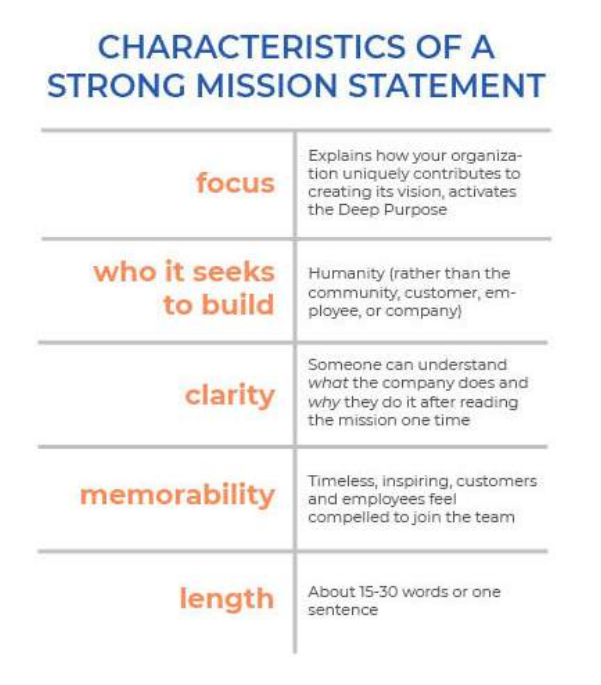
It is commonly understood that a vision statement captures the description of the world that an organization hopes to create. The mission statement is how that organization plans to uniquely contribute to creating that vision and serves as a building block in branding, communication, and strategy. Value statements are guiding principles the company intends to embrace in carrying out their work and give key groups of people a shared set of values to revolve around. Developing this string of value-driven declarations clarifies and orients organizations to a deep purpose, or a connection to the reason why the business really exists. Businesses can create more value if they successfully understand and orient around this existential core. 

Despite this revisioning of the purpose of business, there are three traps that tend to inhibit organizations from identifying with their deep whys. When an organization defaults to profit as its core purpose, it is stuck in the profit trap. When organizations focus only on the product or service they provide, they have fallen into the product trap. Finally, when organizations point to their competitive advantage to explain their organizational purpose, they are in the differentiation trap

Business leaders can fall into these three traps, each diminishing or obscuring the power of a deep purpose, before or after developing vision and mission statements because of the way people are generally taught to think and talk about for-profit firms. When firm leaders fall into one of the mission traps, they are not seeing or communicating the full potential of their organization. However, understanding and revisiting an organization’s deep purpose will help a business to integrate their entire organization around the kind of richly resonant mission that will connect executives, employees, customers, and shareholders to a powerful sense of purpose and identity. Virtuous organizations thrive in understanding and orienting to their deep purpose. 

Many businesses understand that their organization and market exists to fill a need that an individual can’t meet on their own. This understanding is commonly reflected as part of a business problem statement or a statement of need. 

The deep purpose goes beyond needs. It is an organization’s belief about why meeting that need will help a person reach their full potential, or in Maslow’s language, self-transcend. Additionally, it is based on an understanding that an individual cannot reach self-transcendence on their own; they must connect with a community of people or an organization (and its people, products, processes, etc.) to reach that goal. 

Seeking the deep purpose invites organizations to create a vision—a dream of the world they want to see. For example, a health and wellness company’s deep purpose may be the belief that obtaining a maximum level of health will help people to live their best lives, full of happiness, freedom, and connection with others. Thus, they will envision a world in which every person has obtained their maximum level of health. This vision serves as a driving and unifying force within the organization and among stakeholders. The health and wellness company can then derive their organizational mission from their vision—for example, to use their unique understanding of technology and coaching to help people of all ages obtain a maximum level of health. This focuses the organization on the positive influence it wants to have on the world just by existing and performing its usual, day-to-day tasks. For the virtuous organization, objectives shift from a mission emphasis on profits, products, and differentiation (traps) to focus on an organization’s deep purpose—in this case, helping people obtain their maximum level of health.

After developing a vision and mission, an organization may try to capture and communicate their vision and role in achieving it through succinct vision and mission statements. To differentiate between the purpose of a vision and mission statement, William Drohan writes, “A vision statement pushes the association toward some future goal or achievement, while a mission statement guides current, critical, strategic decision making.” 

A strong, focused mission statement brings the unity and clarity essential to the success of a virtuous organization. It shapes a culture that embodies the values of the organization and gives direction and focus to the goals of the company. Inside and outside the company, the brand will gain credibility, influence, and opportunities to make a measurable difference. Everyone from the front line employee to the CEO to the shareholders connect with why they show up to work every day. If they are tuned into the mission, they will be coming for far more than just a paycheck. 

The virtuous organization assertively and effectively incorporates the mission into every aspect of the company. Consider the following statements contrasting the virtuous mission perspective with the three mission traps. 

Profit trap: People pay you because of your mission; your mission is not to get paid. 

Product trap: You have a product because of your mission; your mission is not to produce a product. 

Differentiation trap: You differentiate because of your mission; your mission is not to differentiate. 

Ultimately, visions and missions that fall short of connecting with deep purpose have less capability to motivate organizations toward virtue, while visions and missions that illuminate the deep purpose will orient an organization’s executives, employees, customers, and shareholders to a common (sometimes even universal) problem and a shared need. This connection and shared purpose move an organization toward greater virtue and value creation.